Hierarchical Clustering
We don't expect any pattern in or relationship among the random genes. By comparing clusters of random genes to clusters of differentially expressed genes, we can get some idea of how much of the clustering is due to the actual relationship between the genes. Oddly enough, the randomly chosen genes were closer together than the differentially expressed genes. This is likely due to chance, as there is no reason for there to be a stronger relationship between randomly selected genes than between genes specifically selected because they ought to have a relationship. In the randomly selected genes, Euclidean distance gave cleaner clusters than Pearson correlation. The same main clusters were found for Euclidean distance regardless of linkage method. However, Pearson correlation gave different clusters with complete and average linkage -- six genes moved from one cluster to the other. Given the lack of relationship between the genes, this is not surprising.
When using the Pearson correlation as a distance metric, we can see that the differentially expressed genes form two defined clusters. Both linkage methods returned the same main clusters, but the clusters were not quite as expected. Genes 1-8 showed an increase in expression and genes 9-20 showed a decrease in expression, so it is odd that genes 10 and 19 went with 1-8. Clustering using Euclidean distance as a metric also placed 10 and 19 with 1-8. However, Euclidean distance clustered 15 separately from everything else using both complete and average linkages. Average linkages create smaller distances than complete linkages for obvious reasons. Overall, using Pearson correlation as a distance metric seems to give cleaner clusters that are closer to what we would like. Interestingly, genes 9, 11, and 12, which clustered quite closely using Pearson correlation, were the genes that wound up being used to classify the arrays.
Genes that are clustered together show similar
DNA expression patterns. Clustering genes is an easy way to begin a search for
groups of genes that may work in tandem. Their function (and whether their
expression is in fact related) can be elucidated by further investigation via
more traditional methods.
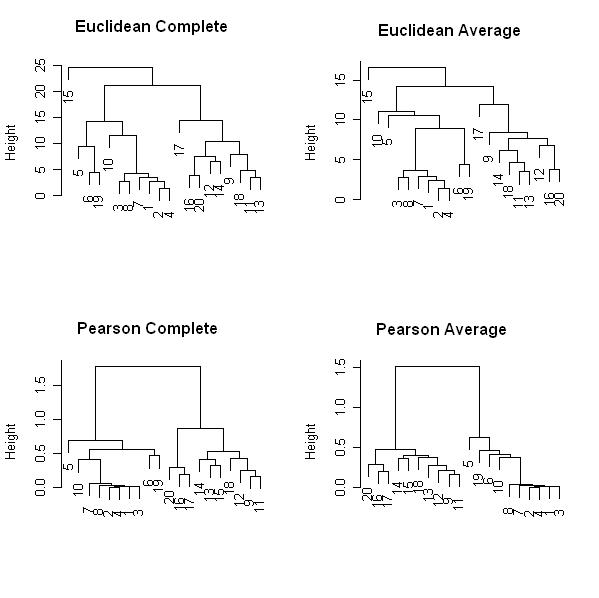
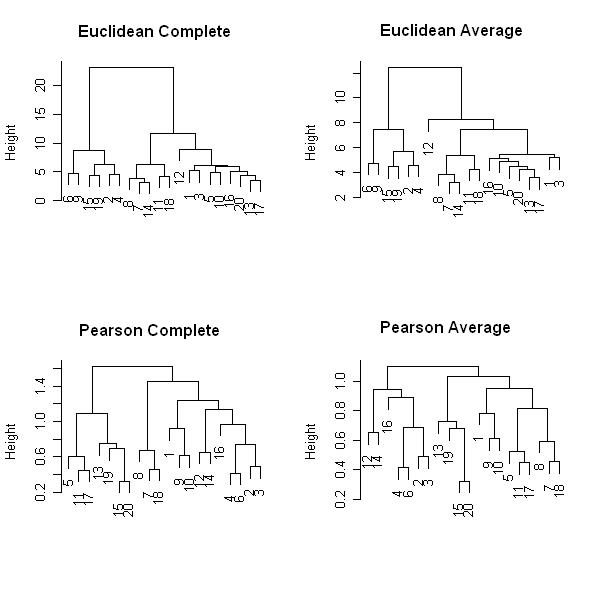
Hierarchical Clustering of Differentially Expressed, Random Genes